Vietnam's Exports Grew 168× in 35 Years. Its Domestic Value Added Fell to 52%
The world's fastest-growing export economy is still assembling other countries' components. That's a vulnerability, not just a statistic.
In 1990, Vietnam exported $2.4 billion worth of goods — mostly rice, crude oil, and textiles. In 2025, it exported $475 billion. No other major economy has grown its exports this fast over the same period. The 168× expansion is not a typo.
The arc is familiar. Vietnam's export trajectory is the textbook case of FDI-led industrialization. The US-Vietnam bilateral trade agreement (2001) opened the door. WTO accession (2007) kicked it down. Samsung built its first phone factory in Bắc Ninh province in 2009. By 2024, Samsung alone accounted for roughly 18% of Vietnam's total exports. Phones and components ($59 billion) and computers ($57 billion) together make up a quarter of the export basket. The US is the top destination market, absorbing $119.6 billion in 2024 — 29% of the total. The bilateral trade surplus with the US hit $105 billion.
But the headline number hides a structural feature that the Trade Audit data makes explicit. Vietnam's domestic value added share of exports — the portion of each export dollar that stays in Vietnam as wages, profits, and locally sourced inputs — has fallen from 76.9% in 1995 to 52.0% in 2020. It is the steepest decline in the OECD TiVA database among major emerging economies.
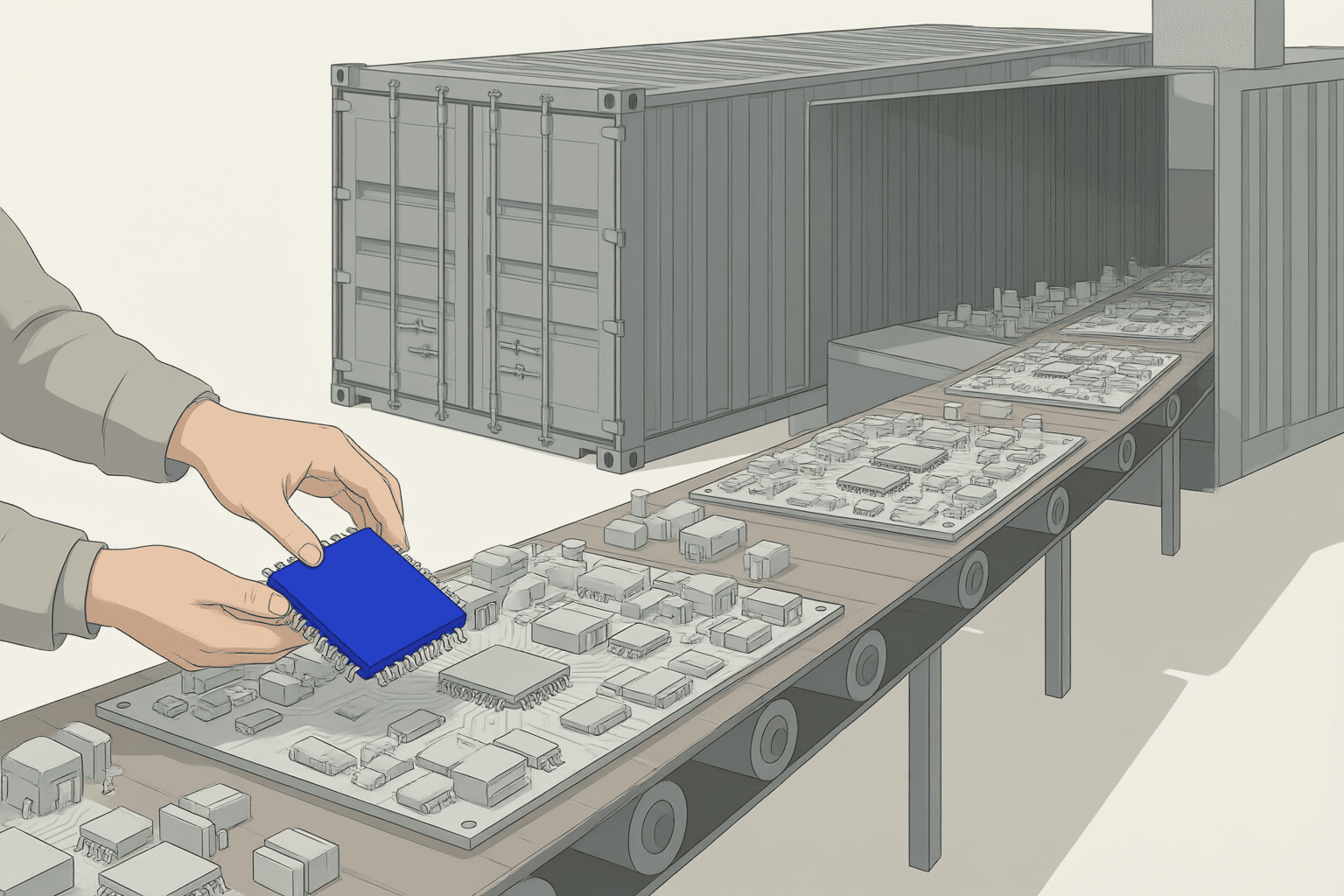
The mechanism is straightforward. As Vietnam moved up the value chain from textiles to electronics, each step required more sophisticated imported inputs. A T-shirt can be made with Vietnamese cotton, Vietnamese labor, and Vietnamese dye. A smartphone requires Korean semiconductors, Chinese display panels, Japanese capacitors, and Taiwanese printed circuit boards. Vietnam provides the assembly — the last and thinnest slice of the value chain. The export number is large. The value retained is not.
This is not a criticism of Vietnam's strategy. The strategy worked. Vietnam went from being one of the world's poorest countries in 1990 to a middle-income manufacturing hub employing millions. The FDI factories brought technology transfer, logistics infrastructure, and integration into global supply chains that would have been impossible to build domestically. The question is not whether the strategy was right. The question is what comes next.
The data points to three specific risks. First, concentration. Samsung alone is a dominant share of exports. Vietnam's export machine is, to a degree that is uncomfortable for any economy of 100 million people, dependent on the investment decisions of a single Korean conglomerate. Second, the US trade surplus. A $105 billion bilateral surplus with the US makes Vietnam a target for tariffs — and Vietnam, unlike China, has limited retaliatory capacity. Third, the shallow value chain. When 48% of every export dollar leaves the country immediately to pay for imported components, the export economy is more fragile than it looks. A supply chain disruption, a sharp currency move, or a protectionist turn in the US or China hits Vietnam's trade balance harder than the headline figures suggest.
Vietnam's trade audit scorecard would show a market share score that is off the charts — the country punches far above its weight in global exports. The value chain depth score would be below expected for its income level. The profitability score would be modest. The defendability score would be weak, driven by high customer concentration (US) and low synergy density — the components Vietnam exports are not inputs to other Vietnamese exports.
The path forward is not mysterious. Vietnam needs to increase the domestic content of its electronics exports — not by restricting imports, which would kill the FDI geese, but by building a domestic supplier base that can replace imported components. This is what Korea did in the 1980s and China did in the 2000s. It requires infrastructure, technical education, and a deliberate policy of supplier development. The alternative is to remain the world's most efficient assembly platform — a good business, but not one that produces a rich country.
Trade Audit Verdict: Market Share: Exceptional · Value Chain Depth: Below expected, declining · Profitability: Moderate · Defendability: Weak · Frontier: Strong (positioned in electronics, the defining growth sector of the last 20 years)