Mexico Overtook China as America's Top Trade Partner. It Still Keeps Only 65 Cents of Every Export Dollar
Nearshoring delivered a record $663.7 billion in exports. The value chain depth is stuck. The two facts are related.
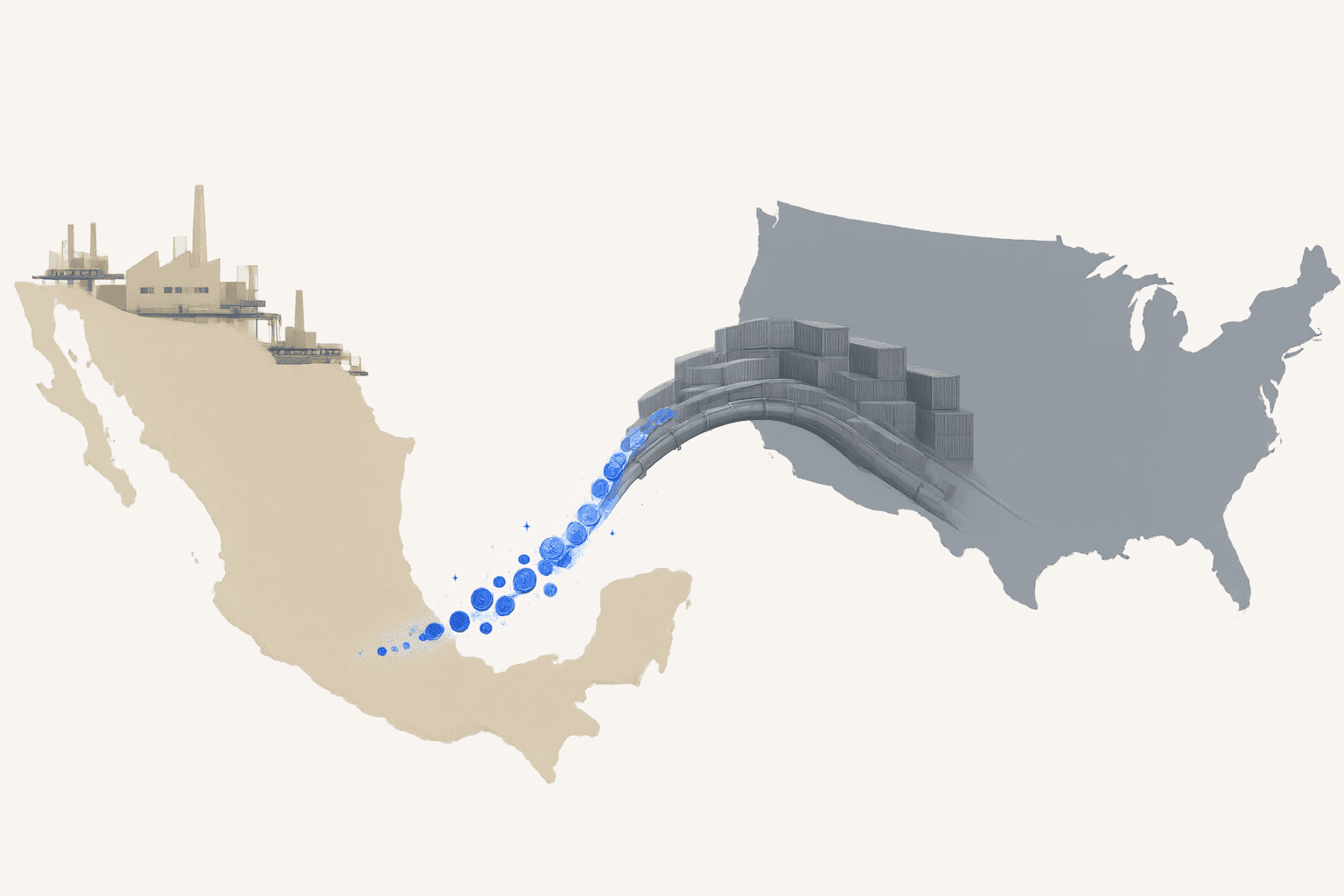
Mexico exported $663.7 billion in goods in 2025, a record. In 2023, it overtook China as the United States' largest trading partner. The nearshoring narrative — US companies pulling supply chains out of China and into Mexico — is real, and the numbers confirm it. Exports have grown from $416 billion in 2020 to $664 billion in 2025, a 60% increase in five years.
The arc is a story of institutional architecture. Before NAFTA (1994), Mexico was an oil exporter — crude oil was 37% of exports in 1983. NAFTA turned Mexico into a manufacturing platform for the US market. The export basket shifted from oil to autos and auto parts ($194 billion, ~30% of exports), electronics, and machinery. The maquiladora system — factories that import components duty-free, assemble them, and re-export finished goods — became the organizing principle of Mexican trade. The system works. Mexico now runs the world's largest bilateral manufacturing supply chain with the United States.
But the Trade Audit data identifies a structural ceiling. Mexico's domestic value added share of exports — the portion of each dollar that stays in Mexico — was 65.0% in 2020. It has been essentially flat for 25 years. In 1995, it was 69.7%. The decline is modest, but the level is low. For comparison, Germany's domestic VA share is 78.6%. China's is 84.2%. The US's is 84.9%.
The mechanism is the same one operating in Vietnam: assembly economics. Mexico imports auto parts from the US, Japan, Germany, and Korea, assembles them into vehicles, and exports the finished cars. The value added is labor, logistics, and a thin margin. The auto sector alone accounts for ~30% of exports, and a large share of the imported components that go into those exports come from outside Mexico. The result is an export number that looks large but a domestic value retained that is modest.
Three features of the Mexican trade profile stand out in the data. First, the US dependency is extreme. ~80% of exports go to one market. This is not a diversified export base — it is a bilateral supply chain. When the US economy sneezes, Mexico catches a cold. The 2009 GFC cut Mexican exports by 21% in a single year. Second, the correlation between Mexican imports and exports is 0.98. Every additional dollar of exports requires roughly 98 cents of additional imports. This is the signature of an assembly economy — the two sides of the trade ledger are mechanically linked. Third, the composition of imports reveals the dependency: 75% of imports are intermediate goods, the components that feed the export machine. Only 15% are consumer goods.
The nearshoring boom has not changed these structural features. It has amplified them. More factories, more assembly, more exports — but the domestic value added share has not improved. Mexico is getting more of the same, not moving up the value chain.
The Mexican trade audit scorecard would show a strong market share score — Mexico over-exports relative to its GDP and population. The value chain depth score would be below expected, and flat. Profitability would be modest. Defendability would be weak, dragged down by extreme customer concentration and low synergy density — the auto sector imports most of its inputs. The frontier score would be moderate — Mexico is positioned in the right sectors but not creating new ones.
The opportunity is clear: Mexico needs to build a domestic supplier base for its own export factories. The auto plants are already there. The foundries, the semiconductor packaging, the specialty chemical plants that feed them are not. The USMCA trade agreement gives Mexico preferential access to the world's largest consumer market. What it does not give — and cannot give — is the industrial ecosystem that turns an assembly platform into a deep manufacturing economy. That has to be built.
Trade Audit Verdict: Market Share: Strong · Value Chain Depth: Below expected, flat · Profitability: Moderate · Defendability: Weak (US concentration) · Frontier: Moderate · Risk: US tariff exposure is existential