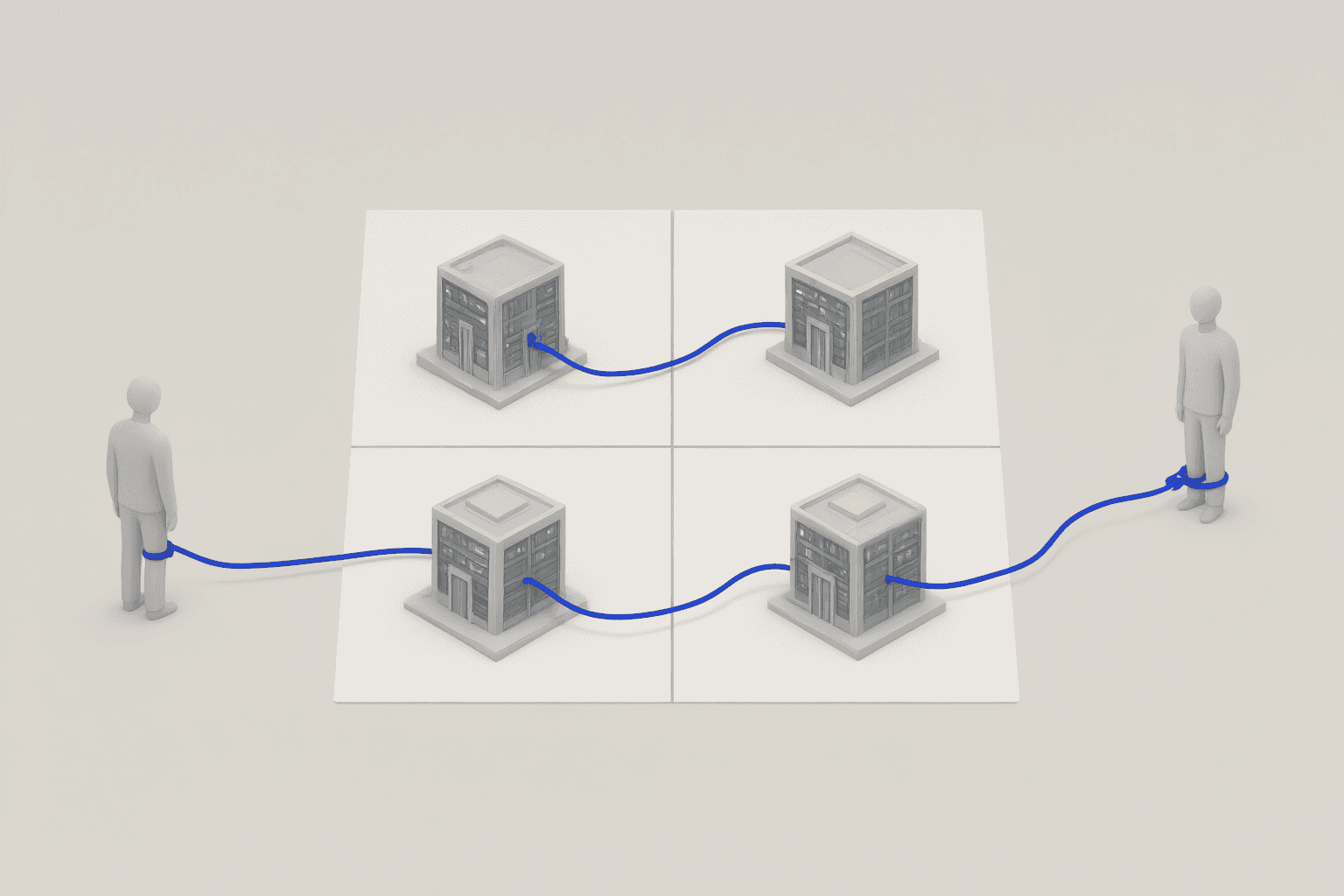
Why the Retail Investor Cannot Solve the Prisoners' Dilemma
The AI buildout is individually rational for every company involved and potentially destructive in aggregate. The index fund owns all of them. That is not diversification. It is a bet that the prisoners collectively produce a tolerable outcome — and that you can identify which cell the warden opens.

The prisoners' dilemma has a feature that is easy to miss. If you own one prisoner, the dominant strategy — confess — is correct regardless of what the other prisoner does. If you own both prisoners through a diversified holding, the dominant strategy produces the worst collective outcome. Your portfolio experiences the aggregate result of two individually rational decisions.
The AI infrastructure buildout is a prisoners' dilemma scaled to $660 billion. The index fund investor — and anyone holding a broad market portfolio — owns all four hyperscalers, the neo-clouds that are going public, and increasingly the AI labs as they access public markets. The question is whether the aggregate outcome of individually rational overinvestment is tolerable for the diversified holder, and if not, what to do about it.
The Dilemma, Formalized
Four companies. Each chooses how much to invest in AI infrastructure. The payoff structure:
- If a company builds aggressively and wins the AI race, it captures a share of a market potentially worth trillions.
- If it builds aggressively and loses, its existing franchise — search, cloud, social media — is eroded by the winner.
- If it builds cautiously and others build aggressively, it loses the platform war.
- If everyone builds cautiously, everyone preserves their franchise and avoids excess CapEx.
Aggressive building is the dominant strategy. Regardless of what competitors do, any single company is better off building more. The individually rational strategy is to spend whatever you can.
But the aggregate payoff — the sum over all participants — is the total value AI creates for public companies minus the total capital deployed. When all four play the dominant strategy, total CapEx reaches $660 billion in 2026, heading toward $1,018 billion in 2027 by Goldman Sachs estimates. Total cumulative spend through 2030 is projected at $5 trillion by JPMorgan.
The collectively rational outcome — invest less, earn adequate returns — is not a Nash equilibrium. Any single defector can capture the game by spending more. The dilemma is structural, not a failure of judgment.
What the Index Fund Actually Owns
A broad market index fund holds all four hyperscalers. Amazon at roughly 3.5 percent of the S&P 500. Microsoft at 6 percent. Alphabet at 3.5 percent. Meta at 2.5 percent. Together they constitute roughly 15 percent of the market-cap-weighted index. The index also holds NVIDIA at roughly 5 percent — the arms dealer selling to all sides. As AI labs and neo-clouds go public and enter the index, the exposure grows.
The index fund experiences the aggregate outcome. If Amazon wins the AI race and Microsoft loses, the index captures Amazon's gains and Microsoft's losses. The net effect depends on whether the winner's gains exceed the losers' losses plus the total cost of the race. The distribution of who wins does not matter. What matters is whether the total value created exceeds the total capital destroyed in the process.
Three scenarios bound the possible outcomes.
Scenario 1: Winner takes enough. AI becomes a $1 trillion annual revenue market by 2030. Public companies capture 70 percent of it. The payback on cumulative CapEx is roughly four to five years at steady state. The index fund does fine. The winners' gains more than compensate for the losers' write-downs.
Scenario 2: The war of attrition. AI is a $300 billion market, closer to cloud computing today. Public companies capture half. Payback stretches past 15 years. The index fund underperforms for a decade. The capital was real. The returns were not.
Scenario 3: The commoditization trap. AI becomes enormous — trillions in economic value — but the value accrues to users, not providers. Open-weight models, thin margins, many competitors. The technology succeeds. The companies that built the infrastructure do not capture the returns. This is the telecom outcome: $2 trillion in market value destroyed between 2000 and 2002, but the fiber enabled Netflix, Google Cloud, and Amazon Web Services. The index fund that held telecom stocks through 2001 never recovered. The index fund that added Google in 2004 and Amazon in the years after captured the upside — but those were different stocks.
The Telecom Precedent, Parameterized
The fiber overbuild of 1996 to 2001 is the cleanest analog. The parallels are structural, not superficial.
Telecom companies spent over $500 billion on fiber infrastructure in the United States alone. The spending was individually rational for each carrier and collectively excessive. At the bottom, no more than 2 percent of installed long-distance fiber capacity in North America was being used, according to Brookings Institution research.
The equipment vendors — Lucent, Nortel — provided vendor financing to customers who used it to buy more equipment. The structure was circular. When the customers defaulted, the vendors were left holding both the bad loans and the collapse in equipment demand. NVIDIA's investments in CoreWeave and Lambda, and its $100 billion in committed vendor financing to OpenAI, follow the same pattern.
Global Crossing went from a $47 billion market capitalization to bankruptcy. WorldCom, the largest bankruptcy in US history at the time, had fabricated $3.8 billion in earnings to sustain the appearance of returns that the business was not generating. The fiber itself was eventually used — by different companies, at pennies on the dollar paid by the original investors. The infrastructure was valuable. The equity and debt of the companies that built it were not.
The difference in this cycle is that the hyperscalers are both builders and users. Amazon builds data centers and runs AWS. Google builds data centers and runs Search, YouTube, and GCP. The application margin may offset the infrastructure loss. But it may not, if the application layer commoditizes faster than the infrastructure depreciates. The index fund cannot separate the two. It owns the builder and the user in the same stock.
When Diversified Participation Is Rational
For the retail investor, the decision to participate in the AI buildout through a diversified portfolio is rational under three conditions. If any one of them fails, the case for indexing weakens.
Condition 1: V_public exceeds ΣC by at least the cost of capital. The total value captured by public companies from AI must exceed the total capital deployed. This is unknowable today. The range of plausible outcomes spans from significantly positive to significantly negative.
Condition 2: The winners are public companies. If the dominant AI company of 2035 is a private entity — or a subsidiary of one that has not yet gone public — the public-market investor paid for the war and does not own the victory. OpenAI remains private. Anthropic has explored an IPO at a $2 trillion valuation but has not yet listed. The infrastructure spending is being done by public companies. The returns may be captured by private ones.
Condition 3: The war ends before the subsidy runs out. If the AI labs reach breakeven unit economics before their capital is exhausted, the demand for GPU compute becomes self-sustaining. The war bonds mature. If not, the demand collapses, the financing unwinds, and the index fund absorbs losses that were funded by the same investor base that bought the equity.
The first condition is uncertain. The second is partially knowable — track which labs are public and which are not. The third is observable in real time through the gross margin trajectories of OpenAI and Anthropic.
For the investor unwilling to accept all three conditions on faith, the alternative to indexing is not avoiding AI exposure. It is selecting the specific companies whose position in the dilemma is least vulnerable to the aggregate outcome.
What a Stock Picker Would Look For
Four characteristics distinguish the companies best positioned to survive the dilemma.
Captive demand. A company that consumes its own GPU capacity for its own applications has a hedge against the spot market. Google uses AI compute for search ranking and advertising. Meta uses it for content recommendation and ad targeting. Their GPU investments do not need to earn a market-clearing rental rate to be valuable. They need to improve the core business margin by more than the depreciation cost. A neo-cloud renting GPUs on short-term contracts has no such hedge.
Deep ammunition. The war of attrition favors the combatant with the largest, most reliable source of funding. Google and Meta have advertising businesses that generate operating margins above 30 percent on hundreds of billions in revenue. Microsoft has enterprise SaaS contracts with renewal rates above 90 percent. The AI labs have venture capital that can close as quickly as it opened.
Acknowledged obsolescence. Amazon's decision to shorten depreciation to five years is a signal. It means the company is pricing its own assets conservatively, which reduces the risk of a future write-down and suggests management is not in denial about δ. Meta's extension to 5.5 years and Microsoft's to six years signal the opposite. A write-down arrives as a surprise to the company that extended, not the one that shortened.
A credible path to breakeven unit economics. Anthropic's gross margin trajectory — from negative 94 percent to 40 percent in 18 months — suggests the technology can reach sustainability. OpenAI's falling gross margin at much larger scale suggests that growth can make the problem worse, not better. The difference is not the technology. It is the customer mix and the cost of the free-tier subsidy.
The Prisoners Cannot Coordinate. The Investor Can Choose.
The prisoners' dilemma is defined by the inability of the prisoners to coordinate. They must each play the dominant strategy. The outcome is determined by the structure of the game, not the wisdom of the players.
The investor is not a prisoner. The investor chooses which prisoners to own, or whether to own the cell block at all. The choice is not between participating in the AI buildout and avoiding it. It is between paying the war premium indiscriminately, through an index fund that holds every combatant, and paying it selectively, through the companies whose position in the dilemma gives them the highest probability of emerging with a franchise intact and a return on the capital deployed.
The index fund cannot solve the dilemma. It can only experience the aggregate outcome. For the investor who believes at least one of the three conditions for rational indexing is likely to fail, the alternative is not exit. It is discrimination.
This is the third of three articles on the economics of AI infrastructure investment. The first, "AI Investments Are the War Bonds of the New Cold War," examines the structure of subsidized demand and the war-of-attrition logic. The second, "What AI Investment Would Look Like in Peacetime," applies the Kelly criterion to the same parameters and calculates the gap between rational capital allocation and observed spending.