$8 Trillion, Three Gulf Wars, and the Ghost of the Athenian Fleet
In 2026, the US opened its third Gulf War in 35 years. Two and a half millennia ago, another maritime superpower made the same bet on a distant, resource-rich region — and lost everything. The mechanism is the same. Only the scale differs.
I. The Topical Hook
The US and Israel launched Operation Epic Fury against Iran on 28 February 2026. Within weeks, Brent crude surged past $118 a barrel. Iranian missiles and one-way attack drones struck targets across nine countries. The Strait of Hormuz — conduit for 21% of global petroleum trade — was partially closed in what the IEA describes as "the largest supply disruption in the history of the global oil market." The direct cost in the operation's first months exceeded $30 billion. Eight major oil companies booked $93 billion in profit in the quarter the war began.
This is the third Gulf War since 1991. The second, the 2003 invasion of Iraq, was projected by the Bush administration to cost $50–60 billion. The Costs of War Project at Brown University now estimates the Iraq War alone at $1.9 trillion to $3 trillion in total obligations. Combined with Afghanistan (2001–2021) and the wider post-9/11 security apparatus, the United States has committed roughly $8 trillion to Middle Eastern military operations. More than 7,000 US service members killed. Fifty-three thousand wounded. Hundreds of thousands of civilian dead across the region.
The 2026 war is not a departure. It is the third iteration of the same decision — the one Athens made in 415 BC.
II. The Historical Parallels
The Peace Dividend, Then Spent
Athens signed the Peace of Nicias with Sparta in 421 BC, ending the first phase of the Peloponnesian War. For six years, tribute from the Delian League flowed at 400 to 600 talents annually. The Laurion silver mines produced another 400 talents. Against annual state revenue of roughly 1,000 talents, Athens accumulated a substantial reserve.
The United States entered its own peace dividend after the Cold War. Defense spending fell from 6.2% of GDP in 1986 to 3.2% by 1999. The first Gulf War in 1991 — a 40-day operation costing $80 billion — was almost entirely reimbursed by allies. It was, by the standards of what followed, a model of limited-war efficiency.
Both powers then spent their surplus on an optional war. Thucydides records that Athens "pitched all the money and resources they had built up over six years of peace into the expedition." The operating cost of the Sicilian fleet — one talent per trireme per month — would have consumed roughly 4,000 talents over two years for 207 ships. Add the reinforcement funds of 300 talents, the initial outfitting, and the value of lost capital equipment, and the expedition likely consumed the equivalent of several years of state revenue. After 9/11, the US defense budget climbed back to 5.7% of GDP by 2010. The wars that followed consumed the peace dividend and then some.
The Self-Funding Fiction
Both expeditions were sold as paying for themselves. The Segestans promised Athens 60 talents of silver to fund 60 ships for one month. They delivered 30. Iraq's oil was supposed to fund its own reconstruction. The Coalition Provisional Authority's initial budget projected $55 billion in Iraqi oil revenue over 2004–2007 to cover reconstruction. Actual oil revenue fell short by tens of billions. The US taxpayer covered the gap.
The Optional War
Neither engagement was existential. Athens' real adversary was Sparta, a land power that could not be defeated in Sicily. The US's primary strategic competitor in the 21st century was a rising China, not a collapsing Ba'athist Iraq or a contained Iran. In both cases, the dominant maritime power chose to fight a secondary conflict far from the main threat.
Sparta exploited Athens' Sicilian disaster immediately. On Alcibiades' advice — he had defected to Sparta after being recalled to face sacrilege charges — the Spartans fortified Decelea, a position in Attica that allowed year-round raiding. The Laurion silver mines were crippled; 20,000 slaves escaped. Athens' primary domestic revenue source collapsed at the exact moment its treasury had been depleted by Sicily.
China, in the decades the US spent in Iraq and Afghanistan, built 40,000 kilometers of high-speed rail, expanded its navy to the largest by hull count, climbed the value chain from low-cost assembly to advanced manufacturing in EVs, batteries, and solar, and extended its trade footprint across the Global South through the Belt and Road Initiative. These are not ledger-line costs of the Iraq War. They are the opportunity cost of strategic attention — a superpower that spends 25 years fighting land wars in the Middle East is not spending those same decades building alternatives to Chinese supply chains.
The Ideological Propellant
Both adventures carried an ideological payload that made withdrawal feel like apostasy. Alcibiades sold the Sicilian expedition in the language of Athenian destiny — Athens as the school of Hellas, the natural hegemon of the Greek world. Conquering Syracuse was not opportunism; it was the logical extension of Athenian greatness. Thucydides writes that the Athenian demos was seized by an "eros" for the expedition, a collective longing that bypassed strategic calculation. Nicias warned the Assembly they were "reaching for an empire while the one you have is not yet secure." He was ignored.
For the post-9/11 United States, neoconservatism provided the architecture. The Iraq War was not only about weapons of mass destruction; it was about democracy promotion, the "freedom agenda," the belief that American military power could remake the Middle East in the image of liberal democracy. The 2002 National Security Strategy argued for military primacy, preemptive action, and the universal appeal of democratic values. The ideology was sincere. It was also, like Alcibiades' vision, a justification that insulated the enterprise from cost-benefit analysis. The 2026 Iran war — sold publicly as dismantling nuclear and security infrastructure — runs on the same logic: one more intervention will deliver the strategic payoff the previous ones promised.
What the Adversary Did With the Time
At Syracuse, the Athenian fleet was bottled up in the Great Harbour, where its superior seamanship was neutralized by confined waters. The Syracusans, advised by the Spartan general Gylippos, modified their triremes with reinforced bows for head-on ramming and deployed skiffs for missile attack. The superior power lost because it fought on terms that negated its advantage.
The US in the Middle East fought insurgencies that negated its technological superiority. The cost of a $20 million Patriot interceptor against a $1,000 one-way attack drone is an arithmetic repeated across three wars. The adversary kept adapting: from IEDs in Iraq to the coordinated drone and missile swarms of 2026, which saturated US and allied air defenses across nine countries simultaneously.
After Syracuse, Athens' allies revolted. Tribute dried up. The empire's subjects had seen the hegemon bleed. After Iraq and Afghanistan, the erosion of US deterrence credibility was subtler but real: adversaries from Russia to the Houthis tested the boundaries of what the post-Iraq US was willing to enforce.
III. Where the Parallel Breaks
The analogy is not clean. Athens lost roughly half its military capacity in a two-year campaign and was stripped of its empire within a decade. The US commitment to the Middle East, while enormous in absolute terms, has consumed roughly 1–2% of GDP annually — comparable to the peace dividend itself, not to the existential mobilization of World War II, which peaked at 35.8% of GDP. The US economy remains the world's largest. Its navy remains dominant. Its technological base leads in critical sectors. The US is not about to be subjugated by a rival.
The adversaries also differ. Syracuse was a democratic city-state with a comparable military, a functioning navy, and competent generalship. Saddam Hussein's Iraq, the Taliban's Afghanistan, and the Islamic Republic of Iran are qualitatively different propositions — weaker, less capable of projecting force, and in the case of 1991, defeated in 40 days. The US was never at risk of losing a conventional battle. It was at risk of winning the battle and losing the war — and the treasury.
And the US learned one thing Athens did not: the 1991 war was limited and reimbursed. The 2003 war was a disaster. The 2026 war, if it remains contained to air and naval operations without a large-scale ground occupation, may split the difference. But the pattern of escalation from one war to the next is not reassuring.
IV. What Survives the Comparison
The comparison is not a prediction. It is a diagnosis of a recurring mechanism.
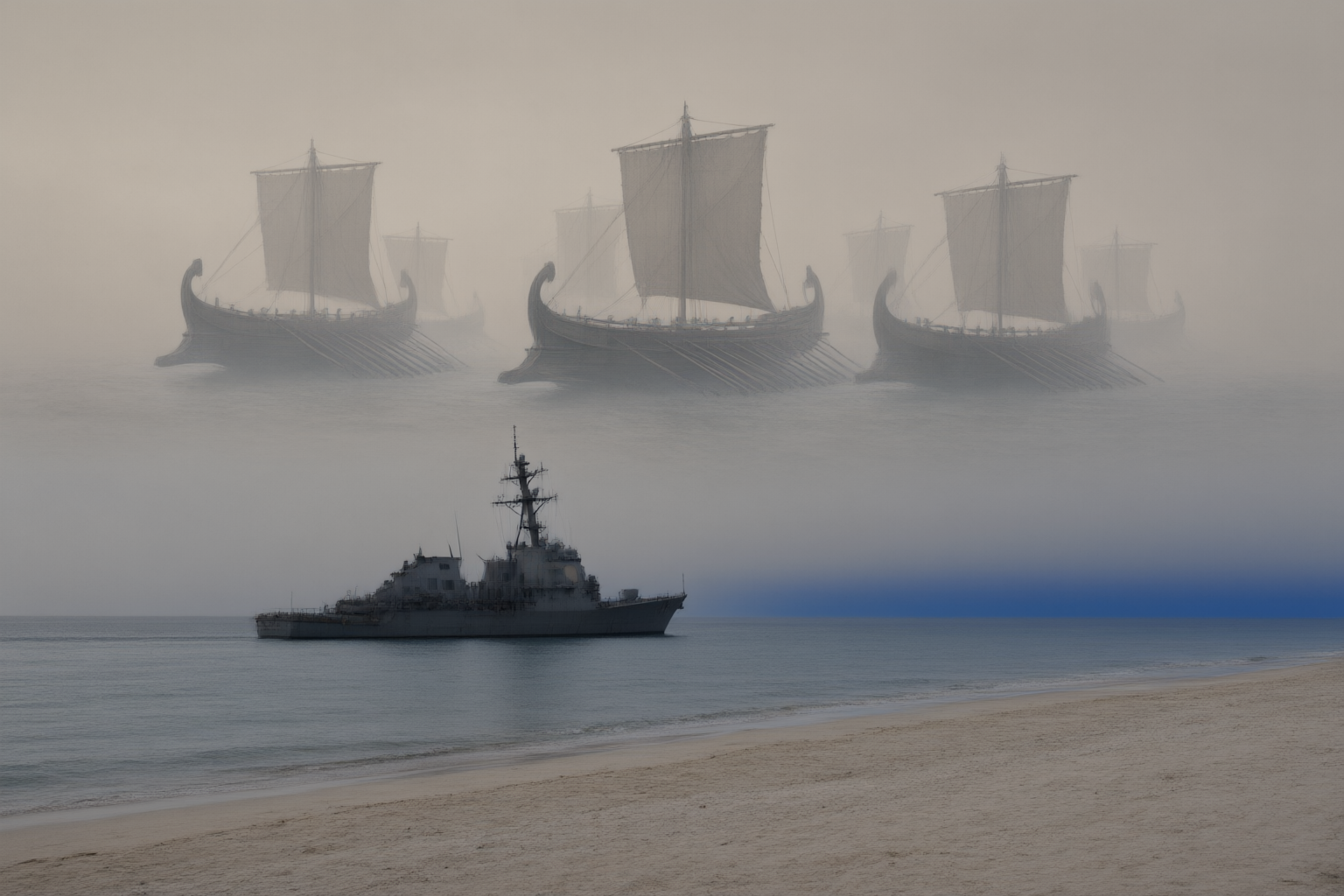
A maritime trading power accumulates surplus during a period of peace. It identifies a distant, resource-rich region as a strategic prize. It convinces itself that a military intervention will be short, self-funding, and decisive. Ideology supplies the moral architecture. The adversary — the one not being fought — uses the distraction to advance. The intervention costs far more than planned, lasts far longer, and delivers far less. The surplus is not invested in the foundations of the power's own strength. It is consumed.
The bill for the post-9/11 wars stands at $8 trillion. That is roughly the cost of building a nationwide high-speed rail network, retrofitting the US electrical grid, and fully funding the CHIPS Act at ten times its current scale — with money left over. It is not a bill that was voted on in a single assembly, like the Athenian fleet. It accumulated across two decades and three administrations, each iteration justified as the one that would finally get it right. The ghost of the Athenian fleet is not in the ledger. It is in the question the Assembly never asked: what could this surplus have built, instead?
Athens ran this mechanism once and was destroyed. The US has run it three times — 1991, 2003, 2026 — and remains the world's dominant power. The difference is not in the mechanism but in the margin for error. Athens had none. The US has a lot. The question the 2026 war poses is how much of that margin remains.
The Quant Historical Dispatch. Sources: Thucydides, History of the Peloponnesian War, Books 6–7; Costs of War Project, Brown University; Congressional Research Service, "Costs of Major U.S. Wars"; US Defense Casualty Analysis System; IEA oil market reports; Britannica, "2026 Iran War"; Al Jazeera, "12 Days: How 2025 Iran Blueprint Trapped US, Israel in Longer War"; Wikipedia, "Sicilian Expedition" and "Financial Cost of the Iraq War."